Ciao Going Expat people,
It has been a while but here we are today with a new blog post, and it is a guest post about Expat Burnout, which hopefully will make you feel understood and will prepare you to be kind to yourselves.
A topic that very well goes with the last newsletter published a couple of days ago, in fact it can be hard to adapt to a new “everything” and burnout is most likely to happen.
And this is also a topic so close to my heart due to so much wrong info about moving abroad, in general, you find online.
Let’s first introduce the author, before dive into the topic and read her words.

Emanuela Les is a Certified Stress and Burnout Specialist
Having experienced the expat life in the Netherlands and burnout myself, I now coach expats living in the Netherlands to help them recover from burnout using reflection-based tools and nervous system practices, so they enjoy the life they built abroad.
If you live abroad, you’ve probably also felt the constant need for sleep and rest that kicks in a few years after moving to the Netherlands, or any other country.
The continuous need to prove yourself and your value, to find belonging, and the daily effort you have to put into living a life abroad can leave you drained and can even lead to burnout.
A 2024 reliable Cigna study found that from those who are globally mobile, a staggering 96% of them experience burnout and 86% report extreme stress. In the Netherlands that situation seems to be slightly less frightening with 79% experiencing burnout and 68% reporting extreme stress.
But where do these numbers come from? How do the demands of expat life lead to burnout, and what are some practical steps that can help us better manage expat burnout?
Regular Burnout vs. Expat Burnout
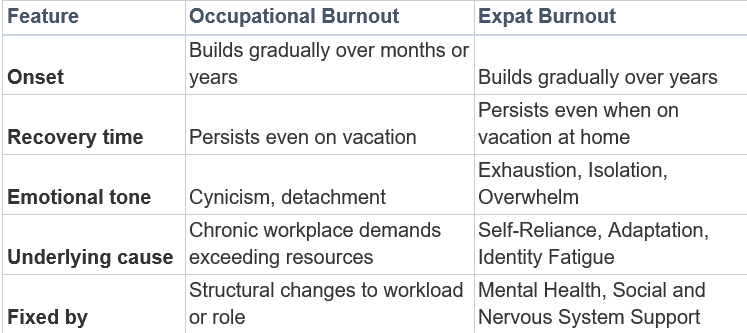
When talking about burnout, we usually think about the most known version of it, the occupational kind of burnout.
On the other hand, expat burnout is a nervous system response to the demands of expat life.
Expat burnout is similar to occupational burnout, however, it is not about work as much as it’s about having no one else but yourself to depend on.
In fact,having to adapt to a new culture, language, administration or laws, and building a new life in a foreign place..
All these stressors repeated daily and for years on end can push our nervous systems into overdrive, deplete our energy and affect our cognitive abilities.
Regular Burnout vs. Expat Burnout
For many of us, isolation doesn’t mean just being alone in a new country.
This also means facing financial pressure alone, with no safety net to rely on. It requires maintaining an image of being capable and strong. Relying only on yourself creates a growing isolation. The more you need help, the less you ask. That pattern stops you from seeking support.
This leads many of us to focus on work and pay checks. We neglect our personal life and well-being. Getting a good job and keeping it often seems more important than taking a well-deserved holiday. It also seems more important than hanging out with friends on a Friday evening.
At the same time, when we do interact with their environment, this can also prove exhausting. Constantly adjusting to Dutch culture causes fatigue. The fear of making grammatical mistakes when speaking to Dutch natives adds stress. Exposure to new social norms can lead to culture shock. This drains our energy and makes us feel overwhelmed in socially demanding situations.
Ultimately, these feelings of confusion and overwhelm can make us feel like outsiders and influence the way we see ourselves. Not to mention, when we feel the effort to adapt is not paying off, we feel energy declines. We also lose energy that we would gain from regular achievements. The life we seek begins to seem like a toxic job draining resources.
What expats get wrong about resting
The number one mistake we tend to make in the hope of fixing our burnout is thinking that a holiday will restore our depleted energy reserves, or that a day on the couch while scrolling on Tik Tok counts as real recovery. These are passive forms of rest that do not offer a sustainable solution or a boost of energy. They just offer a break from the stressors, stop the energy expenditure and by the end we still feel tired.
The second mistake is not prioritizing feeling at home in our own body. Years of stress have built up, leaving our minds running nonstop. Our bodies lack energy for daily tasks. Daily demands overwhelm our nervous systems. Facing the causes of our burnout can feel painful. Staying distracted with social media, vices, or work seems more relaxing.
The third mistake is not taking time to enjoy the things that make us happy. This happens in the name of a paycheck. Many people tell themselves, ‘I’ll do it another time,’ when thinking about learning something they are interested in. This habit delays growth and prevents enjoyment. From personal experience, I can say “A lot of times.” However, taking time for ourselves signals our nervous system that it is safe to practice self-care. It also shows that we matter, too.
Practical Recovery Steps
The most helpful thing we can do for ourselves as expats is to take care of our mental and physical health. Making an appointment with the Dutch GP can seem daunting. Being honest about burnout helps, and acknowledging we need help is important. When we consider the long-term benefits, the support offered to expats is valuable. A GP can refer us to professional support and resources within the community. Being honest about the struggles we face helps us. Acknowledging that we need help can mentally prepare us to seek the support we need and ease isolation.
Fixing our relationship with work is another step in tackling expat burnout. This is especially true for those who postponed enjoyable activities to appear productive and valuable. Taking breaks is a small but effective step. Setting boundaries around work is another. Taking on less responsibility shows our nervous systems that it is safe to step away from work.
Finally, re-learning how to enjoy the things we used to like is another way to soothe our nervous systems and boost our energy. Often, even in happy moments, many of us can find ourselves worrying about work, our to-do list or issues we need to resolve. However, practicing our relaxation skills and our ability to detach from work can compound into finally being able to take a full day off or picking up a new hobby we’ve been wanting to try.
Be aware of the demand of Expat life
The demands of expat life can leave many of us feeling burnt-out. The constant need to adapt and fit in can create feelings of isolation, overwhelm and confusion. Ultimately this can lead to self-reliance fatigue and identity crisis. From there, the regulated nervous system cannot restore the energy needed for managing expat demands and burnout is more likely to occur.
However, taking practical steps that focus on our well being, nervous system regulation and re-creating a more harmonious relationship with work can help us restore our energy, feel more confident and access the necessary support. This in turn, reduces the isolation many of us feel as expats, helps us better manage the demands of expat life and ameliorate burnout.
Now that you know why expat burnout happens, what drives it and how to tackle it in practical steps, what is your first step towards recovery?
Burnout is part of one of the cost of migration, and we definitely need to be aware of it to protect our well-being.
I cannot thank Emanuela enough for this wonderful blog post about such an important topic.
Hopefully it can help you folks understanding better your feelings or the feeling of the people who are around you and migrated.
Take care and talk to you all soon
Rossella